 简体中文
 繁體中文
 English
 Français
 Русский
 日本語
 Tiếng Việt
 한국어
 Deutsch
 Español
 Italiano
 Português
 العربية
 ไทย
 Bahasa Indonesia
 Bahasa Melayu
 Türkçe
 Polski
 Nederlands
 Dansk
 Norsk
 Қазақша
Kimi K2 Thinking Guide: Healthcare Literature Review with Citation Audits
A developer-focused kimi-k2-thinking guide guide covering architecture, code, alternatives, cost controls, and production rollout.
Kimi K2 Thinking Guide: Healthcare Literature Review with Citation Audits#
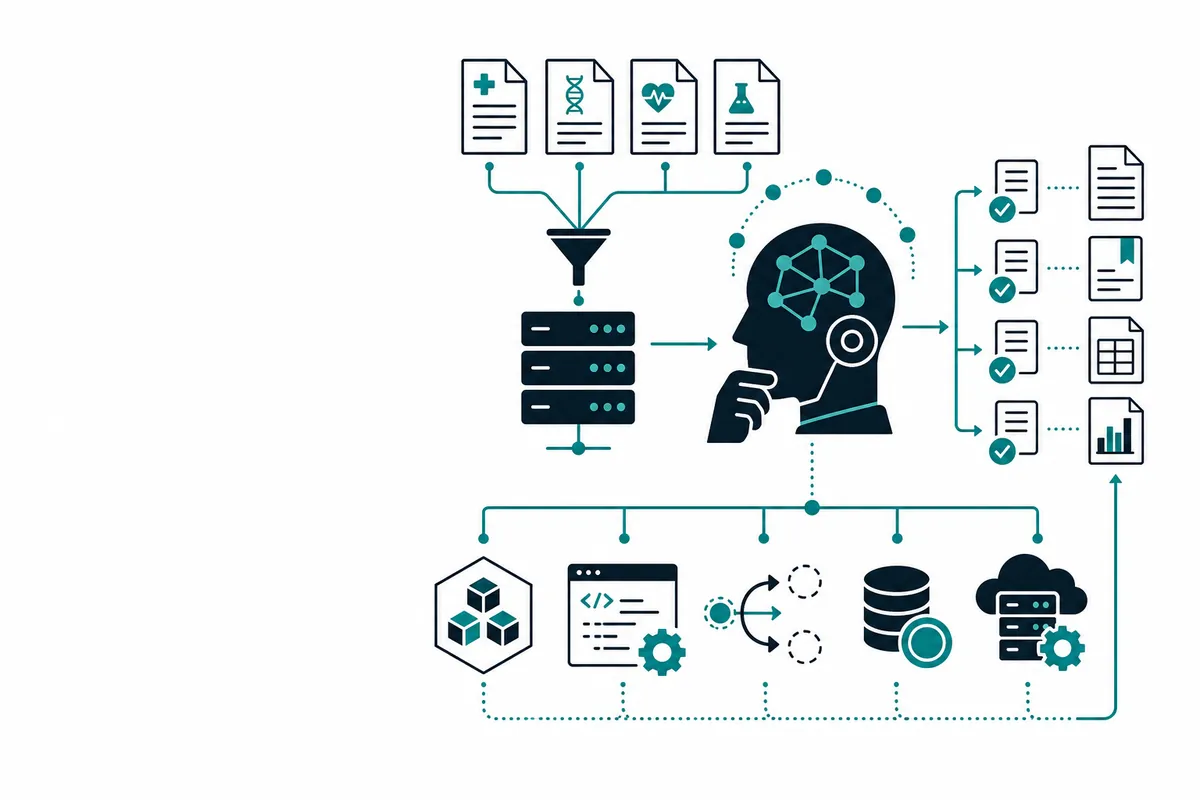
Teams rarely fail with Kimi K2 Thinking because they cannot make a demo. They fail when the demo becomes a service: requests arrive concurrently, costs become difficult to attribute, provider errors leak into the product, and nobody can explain why an output was accepted. This kimi-k2-thinking guide guide focuses on that production gap. The goal is to build a literature-review assistant that separates retrieved evidence from model conclusions while keeping the integration observable, replaceable, and economical.
Quick answer: Kimi K2 Thinking is a strong option for query planning, retrieval, evidence extraction, citation verification, and report drafting. Use the native product when its workflow and account controls fit your team. Use a model gateway when you need one API contract, centralized metering, or fallbacks across providers.
What is Kimi K2 Thinking?#
Kimi K2 Thinking is an AI capability aimed at developer or production workflows rather than a single conversational prompt. In practice, an application sends structured input, receives generated or analyzed content, validates it, and then stores or acts on the result. The important architectural decision is not merely which model wins a benchmark. It is where you put authentication, policy, retries, budgets, and quality checks.
A maintainable integration separates four layers:
- Product logic defines the user-visible job and success criteria.
- Provider adapter translates your stable request into a model-specific payload.
- Control plane applies budgets, routing, retries, and audit metadata.
- Evaluation layer decides whether the output is usable, retryable, or requires a human.
This separation lets you test Kimi K2 Thinking without coupling every service to one SDK. It also makes a later comparison with DeepSeek reasoning models and Claude a configuration change rather than a rewrite.
Kimi K2 Thinking vs alternatives#
| Decision factor | Kimi K2 Thinking | DeepSeek reasoning models and Claude | Multi-model gateway |
|---|---|---|---|
| Best fit | Workflows optimized for its native strengths | Useful for independent quality and cost baselines | Teams needing centralized access and routing |
| Integration effort | Lowest with the native SDK | A separate SDK and auth path per provider | One OpenAI-compatible contract for many models |
| Failure isolation | Requires application-side fallback | Requires application-side fallback | Can centralize fallback and policy |
| Cost visibility | Provider dashboard | Separate provider dashboards | Consolidated request metadata and spend controls |
| Lock-in risk | Medium if payloads leak into business logic | Medium for each additional adapter | Lower when the application owns a stable schema |
Do not choose solely from a public leaderboard. Build a 30- to 100-case evaluation set from real inputs. Score task completion, invalid-output rate, latency, reviewer time, and cost per accepted result. A cheaper request can be more expensive if it doubles manual review.
How to use Kimi K2 Thinking with code#
The following examples use an OpenAI-compatible endpoint so the application can keep one transport while selecting kimi-k2-thinking. Store keys in a secret manager; never commit them.
cURL#
curl https://ai.crazyrouter.us/v1/chat/completions \
  -H "Authorization: Bearer $CRAZYROUTER_API_KEY" \
  -H "Content-Type: application/json" \
  -d '{
    "model": "kimi-k2-thinking",
    "messages": [
      {"role": "system", "content": "Return concise JSON with status, risks, and next_action."},
      {"role": "user", "content": "Process this production job using the supplied policy."}
    ],
    "temperature": 0.2
  }'
Python with timeout and validation#
import os, json
from openai import OpenAI

client = OpenAI(
    api_key=os.environ["CRAZYROUTER_API_KEY"],
    base_url="https://ai.crazyrouter.us/v1",
    timeout=45.0,
)

response = client.chat.completions.create(
    model="kimi-k2-thinking",
    messages=[
        {"role": "system", "content": "Return JSON: status, risks, next_action."},
        {"role": "user", "content": "Evaluate the queued job against policy."},
    ],
    temperature=0.2,
)
result = json.loads(response.choices[0].message.content)
if result.get("status") not in {"approved", "review", "rejected"}:
    raise ValueError("invalid status")
print(result)
Node.js with an idempotency key#
import OpenAI from "openai";
import crypto from "node:crypto";

const client = new OpenAI({
  apiKey: process.env.CRAZYROUTER_API_KEY,
  baseURL: "https://ai.crazyrouter.us/v1",
  timeout: 45_000,
});

const jobId = crypto.randomUUID();
const result = await client.chat.completions.create({
  model: "kimi-k2-thinking",
  messages: [
    { role: "system", content: "Return JSON with status, risks, next_action." },
    { role: "user", content: `Evaluate job ${jobId} against policy.` },
  ],
  temperature: 0.2,
});
console.log(jobId, result.choices[0].message.content);
For media or long-running jobs, treat submission and completion as separate operations. Persist a job ID, poll with exponential backoff or consume a webhook, and make the completion handler idempotent. Never bill a customer twice because a webhook was delivered twice.
Production workflow and quality gates#
For query planning, retrieval, evidence extraction, citation verification, and report drafting, use an explicit state machine: queued -> running -> validating -> approved|review|failed. Record the model identifier, prompt version, input hash, latency, token or media usage, and validator result. Do not log secrets or raw private inputs unless retention is justified.
A practical validation stack has three levels. First, schema validation rejects malformed output. Second, deterministic rules check dimensions, required fields, citations, safe zones, or allowed tool actions. Third, a small rubric-based reviewer estimates usefulness. Human review remains mandatory for high-impact medical, financial, legal, identity, or irreversible actions.
Retries should be narrow. Retry network timeouts, 429 responses, and transient 5xx errors with jitter. Do not blindly retry policy rejection or malformed input. Cap attempts, then route to a compatible fallback or a review queue. This prevents a single bad job from becoming an expensive retry storm.
Pricing breakdown and cost control#
Prices and model availability change frequently, so confirm live rates before launch. Model cost is only one component; include retries, storage, egress, evaluation, and human review. Track cost per audited-report, not just cost per token or generation.
| Cost dimension | Official/native access | Crazyrouter access |
|---|---|---|
| Billing | Direct provider account and current official rate | Pay-as-you-go gateway balance and live model rate |
| Models | Provider's own catalog | Multiple providers behind one API key |
| Engineering overhead | Separate auth, SDK, limits, and invoices | Shared client, routing, and usage metadata |
| Fallback cost | Build and operate another integration | Route to an approved alternative model |
| Best choice | Maximum native feature coverage | Multi-model testing, portability, and centralized control |
Create three budget limits: per request, per user per day, and per environment per month. Reject unexpectedly large inputs before calling the model. Cache safe deterministic results, batch offline work, and reserve premium models for cases where evaluations show a measurable gain. The cheapest architecture is usually a model mix, not one model for every request.
You can explore compatible models and current rates on Crazyrouter and verify the exact model ID before deploying.
FAQ#
Is Kimi K2 Thinking suitable for production?#
Yes, if you add timeouts, validation, idempotency, monitoring, budget limits, and a documented fallback. A successful demo alone is not a production readiness test.
Is Kimi K2 Thinking better than DeepSeek reasoning models and Claude?#
Not universally. Compare them on your own acceptance set. The winning model is the one with the lowest cost per accepted result under your latency and policy constraints.
Should I use the official API or a gateway?#
Use the official API for the newest provider-specific features and direct account control. A gateway is useful when portability, consolidated billing, rapid model comparison, and fallback routing matter more.
How should API keys be stored?#
Use server-side environment injection or a managed secret store. Scope access by service and environment, rotate keys, redact logs, and never expose a provider key in browser or mobile code.
How do I prevent unexpected bills?#
Set hard application quotas, validate input size, cap retries, record usage per tenant, alert on anomalies, and test fallback prices. Reconcile your internal ledger with provider or gateway usage regularly.
What should I measure after launch?#
Measure acceptance rate, p50 and p95 latency, retry rate, fallback rate, reviewer minutes, safety incidents, and cost per audited-report. These metrics reveal whether a model is actually improving the product.
Summary#
A robust kimi-k2-thinking guide decision combines model quality with architecture. Keep provider details behind an adapter, validate every important output, make asynchronous handlers idempotent, and budget against business outcomes. Start with a small evaluation set, compare Kimi K2 Thinking with DeepSeek reasoning models and Claude, then roll out gradually.
If you want to test several model families without maintaining separate clients, create a Crazyrouter account, inspect current pricing, and run the same evaluation payload through approved alternatives before committing production traffic.